 L'Amade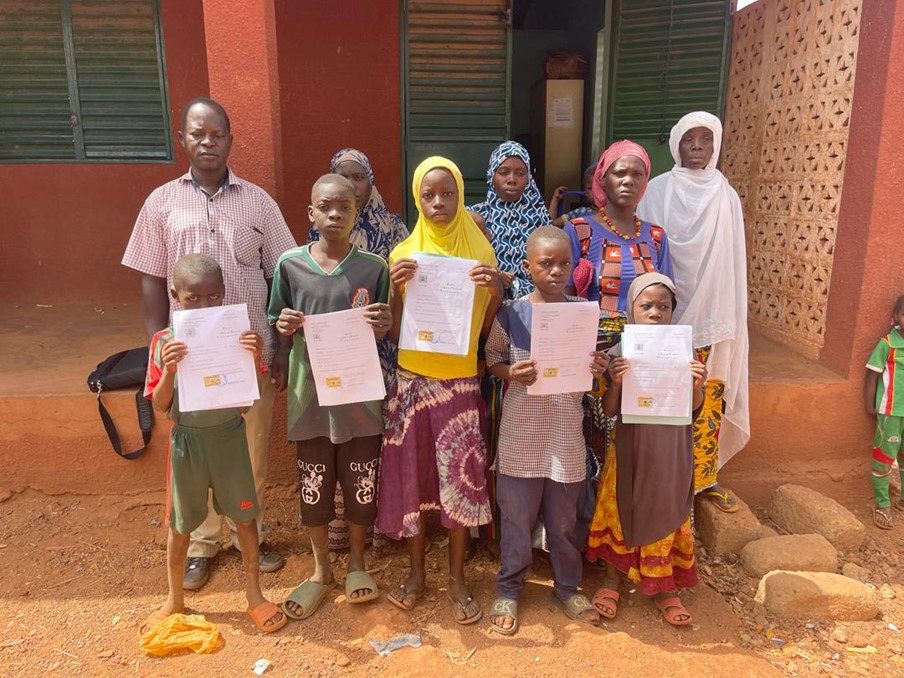
The right to legal identity remains a major issue in Burkina Faso, as it is a prerequisite for the exercise of all fundamental rights of the child.
However, despite the efforts of the government and its partners, universal access to civil registration remains insufficient. According to the Directorate General for the Modernisation of Civil Registration (DGMEC, 2024), the rate of birth registration within the legal deadline of two months is only 60.65% at the national level, leaving nearly 4 out of 10 births undeclared within the legal deadline. This delay accumulates year after year, creating a large pool of people without birth certificates and compromising national and local development planning.
According to the World Bank, more than 6 million Burkinabe cannot prove their existence because they do not have a birth certificate (2018 study, cited by DGMEC). This deficit particularly affects children, women, and internally displaced persons (IDPs). In 2019, nearly 4 out of 5 displaced children (75%) under the age of 18 did not have a birth certificate (Protection Cluster, 2021), and as of 28 February 2022, CONASUR recorded 1,814,283 IDPs, 61.3% of whom were children, meaning that approximately 834,000 displaced children did not have a birth certificate.
In many communities, particularly rural ones, birth registration remains poorly understood and perceived as an administrative formality with no immediate importance. A survey conducted by Tin Tua in 2024 in the municipalities of Kaya and Tenkodogo revealed that 75% of parents of newborns had not registered the birth of their children within the legal time limit, often due to a lack of knowledge of the procedures, but also due to a lack of information about the usefulness of the document.
This situation is exacerbated by persistent social and cultural representations, illiteracy, and the limited availability of community representatives trained in civil status awareness.
Between 2022 and 2024, AMADE and ATT carried out a pilot project that enabled the regularisation of 10,000 children without birth certificates, including more than 4,000 internally displaced children. This project also helped build strong relationships with the national authorities in charge of civil registration and develop a framework for collaboration with various local actors to ensure the sustainability of child regularisation efforts.
Building on these results, the current project aims to build on the solid foundations laid by the pilot phase by strengthening the framework for collaboration established to enable the regularisation of 45,000 children in three municipalities. This project also aims to go further by working with national authorities to test and document the implementation of an automated birth registration system through digitisation and interoperability with health services.
Raising public awareness of the importance of birth registration
Interoperability between civil registry services and health facilities
Digitisation and archiving of birth certificates
Deployment of the digital birth registration platform
Identification and regularisation of children without civil status
1. Community and religious leaders are made aware of the issues and mobilised to contribute to community awareness-raising activities.
2. Communities are made aware of civil registration issues.
3. Children without birth certificates are identified and regularised.
4. The mechanisms implemented to ensure the identification and regularisation of children without birth certificates are capitalised on and documented with a view to rolling them out in other municipalities.
5. A digital archiving solution is deployed in the municipalities involved.
6. Interoperability between health services and civil registration services is operational in the three municipalities involved.
Civil registration for children in Burkina Faso – Phase II
Make a donation-
Burkina Faso
KAYA, TENKODOGO, KOUPELA
-
Project status
In progress
-
Duration
2025-2028
-
Funding
450 000
-
Beneficiaries
65,000 children under the age of 15 without birth certificates
At least 35,000 newborns in the intervention zone
The children's families and communities, who will be made aware of the issue
Local authorities, whose capacities will be strengthened
-
Partners
Tin Tua Association
Directorate General for the Modernisation of Civil Status (DGMEC)
Ministry of Basic Education, Literacy and the Promotion of National Languages (MEBAPLN)
-
Objectives
Contribute to improving civil registration systems in Burkina Faso to guarantee the fundamental rights of children without birth certificates.